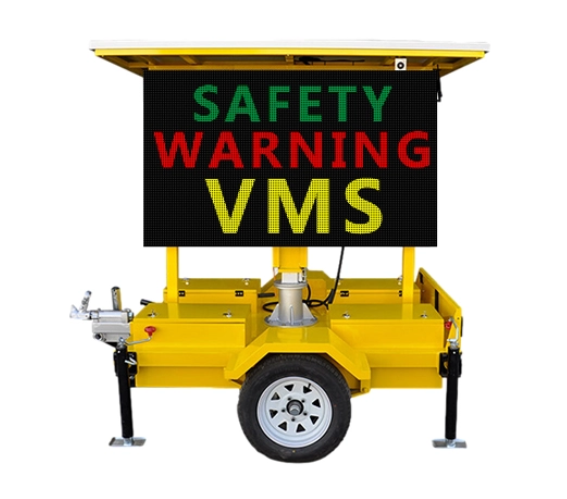
Whether you're managing a road construction project, coordinating traffic control, or organizing a large public event, effective communication with drivers is essential. A VMS trailer (Variable Message Sign Trailer) provides a flexible and highly visible way to display real-time information, helping improve safety, reduce congestion, and keep traffic moving efficiently.
However, not all VMS trailers are built for the same applications. Choosing the right model can significantly impact operational efficiency, maintenance costs, and long-term reliability.
This guide explores the key factors buyers should consider when selecting a VMS trailer for their specific needs.
Road networks are becoming increasingly complex, and temporary traffic changes occur more frequently due to construction, maintenance, emergencies, and special events.
A VMS trailer allows operators to quickly communicate important messages such as:
Road closures
Lane changes
Traffic delays
Speed reduction notices
Event directions
Emergency alerts
Unlike static signs, a VMS trailer can display different messages as conditions change, making it a valuable tool for traffic management teams, contractors, municipalities, and event organizers.
Before purchasing a VMS trailer, it's important to evaluate the features that directly affect performance in the field.
Feature comparison table:
| Feature | Why It Matters |
|---|---|
| LED Display Brightness | Ensures visibility in direct sunlight |
| Solar Power System | Reduces operating costs and improves deployment flexibility |
| Remote Monitoring | Allows message updates without visiting the site |
| Battery Capacity | Supports extended operation during poor weather conditions |
| Trailer Mobility | Enables quick relocation between projects |
| Message Programming | Simplifies traffic communication and scheduling |
When comparing suppliers, focus on overall reliability rather than simply selecting the lowest-cost option.
Many organizations are moving toward solar-powered traffic equipment because it offers both environmental and financial benefits.
A modern solar-powered VMS trailer can provide:
Reduced fuel expenses
Lower maintenance requirements
Continuous off-grid operation
Easier deployment in remote locations
Reduced environmental impact
For long-duration roadworks and infrastructure projects, solar charging systems often provide a more practical solution than generators.
This is particularly beneficial for contractors managing multiple sites simultaneously, where minimizing site visits can save both time and labor costs.
Different projects require different communication strategies.
A VMS trailer helps inform drivers about:
Detours
Lane closures
Speed restrictions
Work zone warnings
Traffic authorities often use VMS trailers to:
Manage congestion
Display travel information
Support incident response
Guide vehicles during emergencies
Event organizers use VMS trailers for:
Parking directions
Venue access information
Traffic routing
Safety announcements
Maintenance crews can deploy a VMS trailer to provide advance warning before drivers reach active work zones.
Selecting the right display size and visibility range depends largely on the type of application and roadway environment.
Traffic control equipment often operates in challenging outdoor conditions.
A high-quality VMS trailer should be capable of withstanding:
Extreme temperatures
Heavy rain
Dust and debris
Long operating hours
Frequent transportation between sites
When evaluating suppliers, buyers should pay close attention to:
Build quality
Corrosion protection
Electrical system reliability
Technical support availability
Warranty coverage
The lowest purchase price may not always deliver the lowest total ownership cost over the life of the equipment.
Technology continues to improve the capabilities of modern VMS trailer systems.
Some emerging trends include:
Cloud-based fleet management
Remote diagnostics
GPS asset tracking
Smart traffic integration
Energy-efficient LED technology
As transportation agencies increasingly adopt intelligent transportation systems (ITS), connected VMS trailer solutions are expected to play a larger role in traffic communication and road safety strategies.
A VMS trailer is far more than a portable electronic sign. It is an important communication tool that helps improve road safety, manage traffic flow, and support efficient project operations.
Whether you're responsible for highway construction, municipal traffic management, utility maintenance, or event coordination, selecting the right VMS trailer requires careful consideration of visibility, power systems, reliability, and long-term operating costs.
By focusing on performance and operational requirements rather than purchase price alone, organizations can maximize the value of their investment and ensure dependable communication in a wide range of traffic environments.
1. What is a VMS trailer used for?
A VMS trailer is used to display real-time traffic messages, roadwork warnings, detour information, safety notices, and event directions.
2. Are solar-powered VMS trailers reliable?
Yes. Modern solar-powered VMS trailers are designed for continuous outdoor operation and can provide reliable performance with minimal maintenance.
3. Can a VMS trailer be controlled remotely?
Many modern VMS trailer systems support remote message updates, monitoring, and diagnostics through wireless communication platforms.
4. How do I choose the right VMS trailer size?
The ideal size depends on road speed, viewing distance, traffic volume, and the type of information being displayed.
5. What industries commonly use VMS trailers?
Common users include road construction companies, traffic management agencies, municipalities, utility contractors, airports, and event organizers.


 English
 日本語
日本語 français
 Deutsch
 Español
 italiano
 русский
 português
 العربية