Traffic Message Sign Terminology
VMS, DMS and CMS are frequently used for electronic roadside signs that can change the information shown to drivers. Depending on the country, transport authority or project specification, the same type of LED traffic display may be called a Variable Message Sign (VMS), Dynamic Message Sign (DMS) or Changeable Message Sign (CMS).
The terminology can be confusing because buyers sometimes assume that VMS, DMS and CMS describe three completely different technologies. In many real traffic projects, however, the difference is mainly terminology and agency convention rather than a strict difference in LED hardware.
In the United States, the current Manual on Uniform Traffic Control Devices uses the term Changeable Message Sign (CMS). The Federal Highway Administration also notes in transportation guidance that dynamic message signs may also be known as changeable or variable message signs.
For buyers and system integrators, the more important questions are therefore usually: Is the sign fixed or portable? What information must it display? How far away must drivers read it? How is it controlled? And what environmental and traffic standards apply?
Fixed electronic message signs can provide drivers with traffic warnings, lane information, travel conditions and route guidance.
| Term | Full Name | Typical Usage | Is It a Different Hardware Category? |
|---|---|---|---|
| VMS | Variable Message Sign | Common international term for roadside signs whose displayed message can be changed. | Not necessarily. It often describes the same general equipment class as CMS or DMS. |
| DMS | Dynamic Message Sign | Frequently used by transport agencies and ITS projects for electronically updated traffic information. | Usually not. The term often emphasizes dynamically updated traffic information. |
| CMS | Changeable Message Sign | Official terminology used in the U.S. MUTCD for signs capable of displaying alternative messages. | It can include several changeable-sign technologies, including electronic displays. |
Short answer: VMS, DMS and CMS should not automatically be treated as three separate LED product categories. Always check the project specification, because the terminology used by the road authority is more important than the acronym alone.
VMS stands for Variable Message Sign. The term describes a traffic sign whose displayed information can be changed according to traffic conditions, incidents, roadworks, weather, lane status or other operational needs.
A modern LED VMS may be installed permanently over a highway, beside a roadway, at an urban intersection or on a portable trailer. The sign can display text, symbols or other approved traffic information depending on the control system and applicable local requirements.
On SEEKSTARLED traffic product pages, the term VMS is used particularly for products such as Highway Variable Message Signs and Solar VMS Trailers .
DMS stands for Dynamic Message Sign. The word “dynamic” emphasizes that the displayed information can be updated as traffic conditions change.
For example, a traffic management center may update a DMS after a crash, lane closure, congestion event or severe weather condition. The sign may then be updated again when the incident clears.
In practice, a device described as a DMS may look and function almost exactly like one described as a VMS. The terminology usually reflects the vocabulary used by the agency or ITS specification rather than a universal hardware distinction.
CMS stands for Changeable Message Sign. In the United States, this is the terminology used by the current Manual on Uniform Traffic Control Devices.
The MUTCD describes a CMS as a traffic control device capable of displaying one or more alternative messages. The category includes permanent and portable electronic signs, while some other types of signs can change their displayed message mechanically or electromechanically.
For current U.S. requirements and terminology, refer to the FHWA Manual on Uniform Traffic Control Devices, Chapter 2L .
Terminology note: the U.S. definition of CMS is broader than “LED highway screen.” If a procurement document specifies CMS, check whether it requires a full-matrix LED sign, a limited-message electronic sign or another type of changeable traffic-control device.
Traffic-sign terminology developed through different national standards, ITS programs, road authorities and procurement systems. As a result, two projects may specify similar hardware using different names.
Often used as a broad international engineering and product term for signs whose displayed information can vary.
Often emphasizes integration with real-time or actively updated traffic-management information.
Commonly used in formal U.S. traffic-control guidance and includes both permanent and portable changeable signs.
For equipment selection, the difference between fixed and portable message signs is usually more important than whether the project calls the device VMS, DMS or CMS.
| Factor | Fixed VMS / DMS / CMS | Portable / Trailer-Mounted VMS |
|---|---|---|
| Installation | Permanently mounted on roadside structures, poles or overhead gantries. | Mounted on a towable trailer so it can be moved between temporary locations. |
| Typical Use | Highways, expressways, urban traffic networks and permanent traffic-management systems. | Roadworks, temporary lane closures, incidents, events and changing traffic-management locations. |
| Power | Often connected to fixed electrical infrastructure. | May use batteries, solar charging or other independent power arrangements. |
| Mobility | Designed for one long-term installation point. | Designed to be relocated according to traffic-management requirements. |
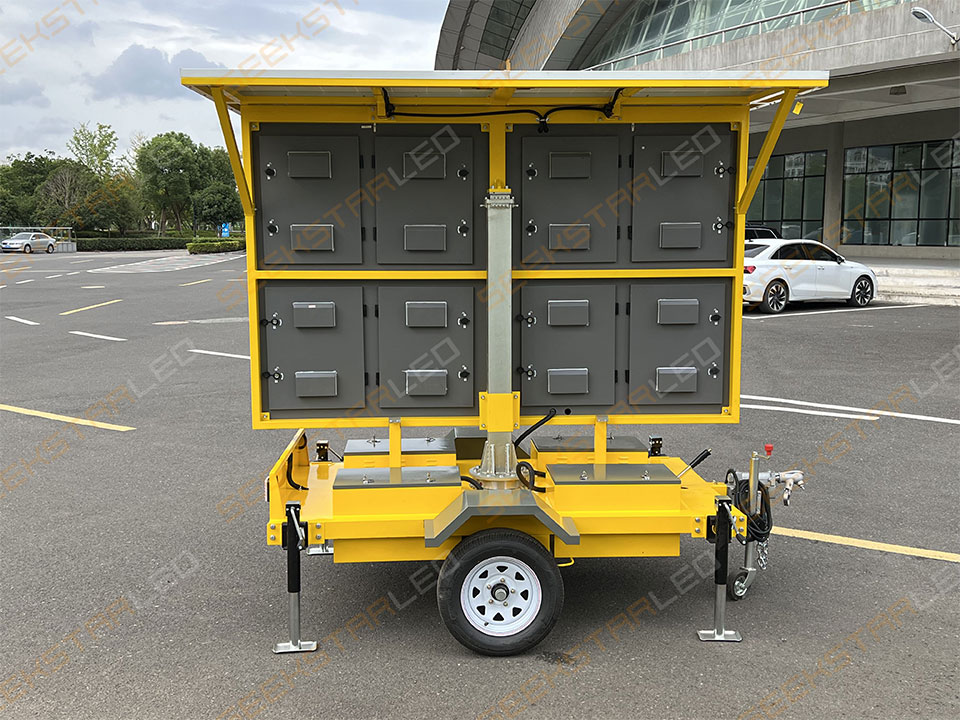
Trailer-mounted VMS equipment provides a portable option for roadworks, temporary traffic management and changing roadside locations.
Another important distinction is the operating environment. A display installed beside a high-speed highway has different visibility and viewing requirements from a sign used at an urban intersection.
| Comparison | Highway VMS | Urban Traffic Guidance Display |
|---|---|---|
| Road Environment | Expressways, highways and higher-speed approaches. | City roads, intersections and lower-speed urban traffic networks. |
| Typical Message | Incidents, lane closures, highway warnings, travel conditions and route information. | Congestion, local routes, lane information, detours and municipal traffic guidance. |
| Viewing Direction | Often optimized primarily for drivers approaching along the highway corridor. | May need to accommodate vehicles approaching from a wider range of urban directions. |
| Product Example | Highway Variable Message Signs | Urban Traffic Guidance LED Display |
The permitted message depends on the traffic authority and applicable standard. In traffic-control applications, the display is generally used for information directly related to road operation, warnings and guidance rather than ordinary commercial advertising.
Crash ahead, blocked lanes, disabled vehicles or other unusual road conditions.
Lane closures, temporary traffic arrangements, reduced access or construction-related instructions.
Delays, queue conditions, travel-time information and possible route alternatives.
Visibility, wind, snow, flooding or other conditions relevant to road operation.
Lane availability, directional information and operational instructions where permitted.
Detours, alternative routes and destination-related traffic information.
This distinction is important because both products use outdoor LED displays and may be mounted on trailers.
A traffic VMS trailer is designed to communicate approved road and traffic information. A mobile LED advertising trailer is designed for commercial advertising, events, promotions and branded media.
| Factor | VMS Traffic Trailer | Mobile LED Advertising Trailer |
|---|---|---|
| Primary Purpose | Traffic warnings and road guidance. | Commercial advertising and event content. |
| Typical Content | Traffic text, warnings, route guidance and approved symbols. | Video, graphics, branding and promotional media. |
| Product Page | Solar VMS Trailer | Mobile LED Advertising Trailer |
Once the terminology is clear, product selection should begin with the road environment rather than the acronym used in the tender.
Highway, urban road, intersection, work zone and temporary diversion projects have different viewing distances, vehicle speeds and installation conditions.
Drivers need enough distance and time to detect, read, understand and act on the message. Character size, sign dimensions and message layout should therefore be planned around the actual approach conditions.
Pixel pitch affects character formation, symbols, display dimensions and pixel density. The finest pitch is not automatically required for a highway sign viewed from long distances.
Outdoor traffic signs must remain readable under changing daylight conditions without becoming unnecessarily bright at night. Automatic brightness control can help the sign adapt to the environment.
Cabinet sealing, drainage, corrosion protection, temperature range and weather exposure should be evaluated for the installation environment.
Determine whether the sign will be controlled locally, remotely from a traffic-management center or through another approved traffic-information system.
Message design, colors, symbols, character dimensions, structural design, electrical systems and traffic-control requirements can vary by jurisdiction. The project specification should govern the final configuration.
A traffic LED display should not be selected by copying the pixel pitch used in a commercial LED billboard. The displayed information, road speed, viewing distance and physical sign dimensions must be considered together.
As an example, SEEKSTARLED's current fixed highway VMS range includes P16, P20, P25, P31.25 and P33.33, while the current urban traffic guidance range includes P10, P12, P16 and P20.
This does not mean every highway should use P16–P33.33 or every city project should use P10–P20. These are product options; the correct pitch must still be selected according to the project's required character size, viewing distance, sign dimensions and local specification.
A technically powerful LED sign can still be ineffective if drivers cannot quickly understand its message.
FHWA guidance emphasizes that traffic messages should be relevant, timely and understandable. The current MUTCD also notes that repeated irrelevant messaging can reduce driver responsiveness to changeable-message signs.
What happened?
Where is the problem?
How does it affect the driver?
What action should the driver take?
For U.S. highway projects, message content and display operation should be checked against the applicable MUTCD requirements rather than copied from a commercial digital-signage design.
Electronic traffic-message signs can be integrated into very different control architectures. The correct choice depends on whether the sign operates independently or as part of a broader traffic-management network.
Centralized System
Suitable when operators need to update signs from a traffic management center or coordinate multiple displays across a road network.
Site-Level Operation
Can be appropriate for certain standalone installations, temporary projects or maintenance activities where local operation is required.
Do not assume that every LED VMS supports the same communication protocol. Controller, interface, traffic-management software and protocol requirements should be specified before ordering.
| Project | Product Direction | Why |
|---|---|---|
| Permanent Highway Information | Highway Variable Message Sign | Fixed roadside or overhead traffic information for expressway and highway environments. |
| City Traffic Guidance | Urban Traffic Guidance LED Display | Designed for city roads, intersections, congestion guidance and urban traffic-information networks. |
| Roadworks / Temporary Traffic Management | Solar VMS Trailer | Portable trailer platform for temporary messages and locations without permanent sign infrastructure. |
| Still Comparing Traffic Display Types | Traffic LED Display | Category overview covering fixed highway, urban and portable traffic-display solutions. |
Urban traffic guidance displays and highway VMS may use similar LED technology but are designed around different traffic environments and viewing conditions.
A tender that says DMS and another that says VMS may still require essentially the same type of full-matrix electronic traffic sign.
Drivers read messages, not pixel-pitch specifications. Required character formation and legibility should guide display resolution.
Traffic-control signs operate under different message, legibility, safety and regulatory requirements.
Outdoor brightness must be balanced with nighttime readability, glare control and local traffic requirements.
A sign cannot be selected independently from its communication method, software and traffic-management architecture.
MUTCD requirements are relevant to U.S. projects, while other jurisdictions may use different road-sign, electrical and structural standards.
A useful quotation needs much more than the words “VMS” or “DMS.” Providing the project conditions helps the manufacturer determine the appropriate screen dimensions, pitch, brightness, cabinet and control system.
Country and applicable traffic standard
Highway, urban road, work zone or temporary traffic application
Permanent or trailer-mounted installation
Required sign width and height, if already specified
Required character height or message format
Typical driver viewing distance and road speed
Monochrome, dual-color or full-color requirement
Required brightness and automatic brightness-control requirement
Ingress protection and environmental requirements
Remote or local control requirement
Required communication interface or traffic-management integration
Available power supply
Structural or mounting requirements
Quantity and project schedule
VMS means Variable Message Sign and DMS means Dynamic Message Sign. In many traffic-management contexts, the terms are used for the same general class of electronically controlled roadside message sign. The preferred term depends on the agency and project specification.
They can refer to the same type of electronic roadside sign, but CMS is a broader formal term in the U.S. MUTCD. A project specification should be checked to determine exactly what type of changeable sign is required.
VMS normally stands for Variable Message Sign, a sign capable of changing the information shown to road users according to traffic or operational conditions.
Yes. Portable VMS units can be mounted on trailers and moved between work zones, incidents, events and temporary traffic-management locations.
No. A traffic VMS trailer is designed for traffic-control messages, while a mobile LED advertising trailer is designed for commercial advertising and event content. Their display technology may be related, but the intended use and regulatory requirements are different.
There is no universal highway VMS pixel pitch. It depends on message format, character size, sign dimensions and viewing distance. SEEKSTARLED's current highway range includes P16, P20, P25, P31.25 and P33.33 options, but the final choice should follow the project specification.
Many electronic traffic signs can support remote information management, but controller, communication method and system integration should be confirmed for the specific project.
Provide the project country, traffic standard, road type, fixed or portable installation, sign dimensions, message requirements, viewing conditions, brightness, environmental protection, power and control-system requirements.
Traffic LED Display Project
Send SEEKSTARLED your road environment, required sign dimensions, viewing conditions, traffic standard, power supply and control requirements. We can compare fixed highway VMS, urban traffic guidance displays and portable VMS trailer configurations for the project.
View Traffic LED Displays Request a Traffic Display Quote

 English
 日本語
日本語 français
 Deutsch
 Español
 italiano
 русский
 português
 العربية